
























New Income, Housing and Waiting Period Requirements Could Reshape the Future of Migrant Families
Healthcare Workers, Agency Staff, International Students and Indian Families Among Those Most Affected
By GNN News Immigration Desk
DUBLIN, June 2026 — Ireland has unveiled a major overhaul of its Non-EEA Family Reunification Policy, introducing stricter financial requirements, detailed housing standards and longer qualification periods for many migrants hoping to bring their loved ones to Ireland.
The new policy, published by the Department of Justice, Home Affairs and Migration on 12 June 2026, represents one of the most significant changes to family migration rules in recent years.
For thousands of Indian families living and working across Ireland, the changes could mean longer periods of separation, higher financial burdens and new challenges in securing family reunification.
PULL QUOTE
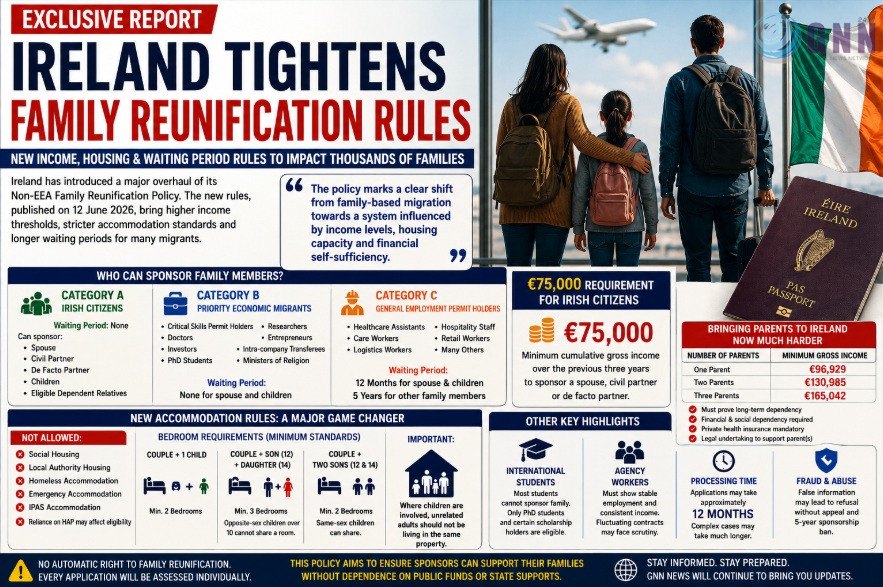
“The policy marks a clear shift from family-based migration towards a system heavily influenced by income levels, housing capacity and long-term financial self-sufficiency.”
WHAT HAS CHANGED?
The Government says the revised framework aims to balance family reunification with growing pressures on housing, healthcare, education and public services.
However, the new rules introduce significantly stricter requirements for many applicants.
Key factors now include:
✓ Immigration status of the sponsor
✓ Financial capability
✓ Suitable accommodation
✓ Waiting periods
✓ Dependency assessments
✓ Public policy considerations
✓ Immigration history
Most importantly, the policy confirms that there is no automatic right to family reunification, even where a genuine family relationship exists.
INFOGRAPHIC: WHO CAN SPONSOR FAMILY MEMBERS?
CATEGORY A
Irish Citizens
Waiting Period: None
Can sponsor:
• Spouse
• Civil Partner
• De Facto Partner
• Children
• Eligible dependent relatives
CATEGORY B
Priority Economic Migrants
Includes:
• Critical Skills Permit Holders
• Researchers
• Doctors
• Entrepreneurs
• Investors
• PhD Students
Waiting Period:
None for spouse and children
CATEGORY C
General Employment Permit Holders
Includes:
• Healthcare Assistants
• Care Workers
• Hospitality Staff
• Retail Workers
• Logistics Workers
Waiting Period:
12 Months for spouse and children
5 Years for other family members
€75,000 REQUIREMENT FOR IRISH CITIZENS
One of the most significant changes concerns Irish citizens sponsoring spouses or partners.
Under the new rules, Irish citizens must show:
€75,000 cumulative gross income over the previous three years
The income must be earned independently of State benefits and must be expected to continue.
Many migrant advocacy groups believe this could affect:
• Lower-income households
• Single-income families
• Part-time workers
• Carers
• Recently naturalised citizens
HEALTHCARE WORKERS: WINNERS AND LOSERS
Indian Nurses
Indian nurses holding Critical Skills Employment Permits remain among the least affected groups.
Benefits include:
✓ No waiting period
✓ Immediate family reunification pathway
✓ Ability for spouse and children to accompany them
However, accommodation and financial requirements still apply.
Healthcare Assistants (HCAs)
Healthcare Assistants are expected to be among the groups most affected.
Many HCAs work under General Employment Permits and therefore fall into Category C.
Before sponsoring family members, they must:
• Complete 12 months in Ireland
• Meet financial thresholds
• Secure suitable accommodation
For newly arrived workers supporting families in India while paying Irish rents, this may significantly delay reunification.
THE NEW ACCOMMODATION RULES
A GAME CHANGER FOR MIGRANT FAMILIES
The housing section of the policy may prove to be one of the biggest practical barriers.
Sponsors must demonstrate that they have accommodation suitable for the family members they intend to bring to Ireland.
The policy states that sponsors should generally not be living in:
✖ Social Housing
✖ Local Authority Housing
✖ Homeless Accommodation
✖ Emergency Accommodation
✖ IPAS Accommodation
The policy also indicates that reliance on housing supports such as HAP may negatively affect eligibility.
BEDROOM REQUIREMENTS
The Government has introduced clear minimum bedroom standards.
Example 1
Couple + 1 Child
Required:
🏠 Minimum 2 Bedrooms
Example 2
Couple + Son (12) + Daughter (14)
Required:
🏠 Minimum 3 Bedrooms
Children over ten years old of opposite sexes cannot generally share a room.
Example 3
Couple + Two Sons (12 and 14)
Required:
🏠 Minimum 2 Bedrooms
HOUSE SHARING MAY BECOME PROBLEMATIC
Many migrants currently rent rooms in shared houses.
The policy states that where children are involved, unrelated adults should not be living in the same property.
This could significantly affect:
• Healthcare Assistants
• Agency Workers
• Hospitality Staff
• New Arrivals
who often rely on shared accommodation because of Ireland’s housing crisis.
BRINGING PARENTS TO IRELAND JUST GOT HARDER
The new policy introduces some of the highest financial thresholds ever applied to dependent-parent migration.
Applicants must prove:
✓ Genuine dependency
✓ Long-term financial support
✓ Continued need for care
✓ Suitable accommodation
✓ Private medical insurance
INFOGRAPHIC: MINIMUM INCOME TO SPONSOR PARENTS
| Number of Parents | Minimum Gross Income |
|---|---|
| One Parent | €96,929 |
| Two Parents | €130,985 |
| Three Parents | €165,042 |
Sponsors may also be required to sign legal undertakings accepting full financial responsibility for the parent.
INTERNATIONAL STUDENTS FACE RESTRICTIONS
Most international students remain unable to sponsor family members.
Only limited categories such as:
• PhD Students
• Certain Government Scholarship Holders
remain eligible.
For married students and those with children, this may reduce Ireland’s attractiveness compared with competing study destinations.
AGENCY WORKERS FACE NEW CHALLENGES
Many Indian migrants work through employment agencies in:
• Healthcare
• Homecare
• Administration
• Hospitality
• Social Care
Under the new framework, applicants may need to demonstrate:
✓ Stable employment
✓ Consistent income
✓ Long-term financial sustainability
Agency workers with fluctuating hours or multiple contracts may face additional scrutiny.
PROCESSING TIMES
Applicants should not expect quick decisions.
The Department indicates that applications may take:
Approximately 12 Months
Complex cases involving parents or exceptional circumstances could take significantly longer.
COMMUNITY REACTION
Community representatives are already expressing concerns that the new policy could disproportionately affect workers who have helped fill critical labour shortages in healthcare, social care and essential services.
Many migrants argue that they contribute through taxes, employment and community involvement, yet now face increasingly difficult barriers when seeking to live together as families.
GNN NEWS ANALYSIS
The revised Non-EEA Family Reunification Policy signals a major shift in Ireland’s immigration philosophy.
While highly skilled migrants such as nurses, doctors, researchers and technology professionals continue to benefit from relatively favourable pathways, lower and middle-income migrants face significantly higher hurdles.
For many Indian families, the challenge will no longer be limited to securing employment in Ireland.
The new reality is that successful family reunification may now depend equally on income, accommodation, long-term employment stability and the ability to remain financially independent of State support.
As Ireland continues to rely heavily on international workers to support healthcare, social care, hospitality and technology sectors, the long-term impact of these reforms will be closely watched by migrant communities across the country.
GNN News will continue to monitor developments and provide updates as further guidance and implementation details emerge.